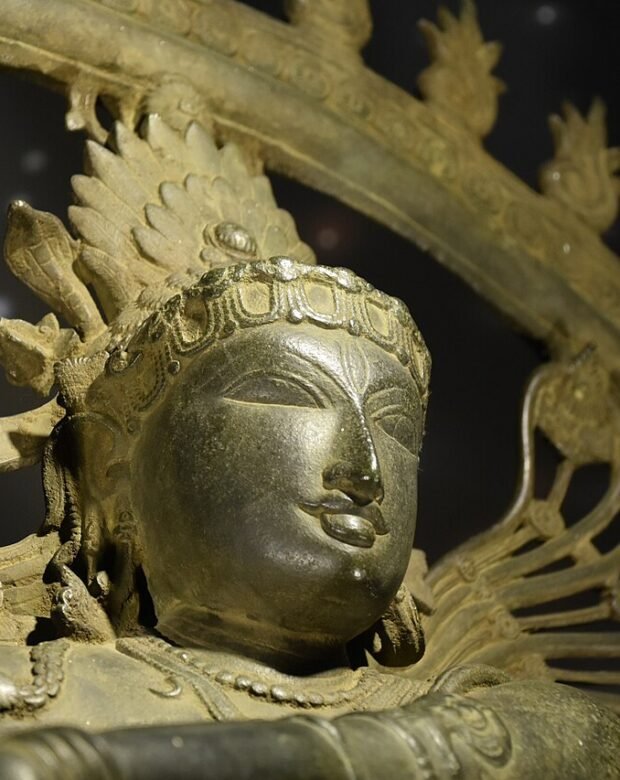
Shiva dances inside a ring of flame, balanced on one leg while the entire cosmos appears to move around him. The Nataraja image presents Shiva as Lord of Dance, joining creation, preservation, destruction, concealment and grace within one controlled bronze form. This article approaches Shiva Nataraja Explained through a close visual encounter separated from the myths created by fame, keeping visual pleasure close to documented history. The purpose is not to empty the subject of wonder, but to replace vague mystery with better questions.
Artwork facts and first encounter
Chola-period and later South Indian bronzes were made for worship and procession, so iconography, casting and ritual life must be read together. Fame compresses an artwork into one instantly recognisable image. A fuller reading restores scale, material, original setting and the sequence by which a viewer discovers its details. Separate what can be seen from what documents confirm and what later interpretation proposes. That discipline makes the familiar object strange—and visible—again. In this case, drum and flame offer two different points of entry: one can establish the larger argument while the other tests how well it holds at the level of a particular work or practice.
What the maker constructed
The making of the subject involved copper-alloy bronze, wax modelling, clay moulds, casting, finishing and ritual adornment. Some processes rewarded collaboration, others protected a specialist secret, and many demanded repeated stages that photographs flatten into one finished image. Tool marks and joins can preserve that sequence. They remind us that artworks entered history through hands, time and resistance. For Shiva Nataraja Explained, place special attention on copper-alloy bronze and wax modelling: their behaviour helps explain why the work looks, moves, ages or circulates as it does.
The detail that changes the whole
A visual route through the subject might pass through drum; flame; raised hand of reassurance; hand pointing to the lifted foot; dwarf of ignorance; flying locks of hair; ring of fire. The route should pause at differences in scale and function, because an intimate page and a public monument ask opposite things of the body. What links them is not a single style but a history of deliberate visual choices. The reader’s task is to identify those choices. Move first through drum, then compare it with flame; keep raised hand of reassurance nearby as a reminder that no single celebrated example can carry the whole field.
Meaning, evidence and uncertainty
The image is often explained as a universal symbol of science or cosmic energy, but those modern comparisons should not replace Shaiva theology and temple context. The modern story can therefore be as revealing as the original history. Excavation, nationalism, collecting, restoration and mass reproduction have all changed the frame through which viewers approach the work. Naming that frame does not diminish the object; it explains its present power. For Shiva Nataraja Explained, museum records, archaeological reports, conservation studies, primary documents and later retellings may emphasise different facts; the differences between them are themselves historically useful.
From original setting to modern fame
Start by mapping balance, rhythm, mudra, attribute, halo, hair, facial calm, contact with the pedestal and the changing view as the bronze moves in procession. Notice where vision accelerates, where it pauses and which details seem to disappear at the edge. Such patterns are part of the work’s rhetoric. They show how looking is guided rather than merely received. For Shiva Nataraja Explained, let the eye move deliberately from balance to rhythm and then outward toward mudra; changing distance often reveals how attention has been organised. Describe what is visible before translating every detail into symbolism, then test a possible interpretation against the object record and historical context.
How to look at it now
Nataraja became one of the most recognised forms of Indian art while remaining a living sacred image in many communities. Modern fame can make a work instantly visible and historically invisible at the same time. The remedy is not to reject popularity but to deepen it with context. Recognition should lead to more demanding forms of attention. In the case of Shiva Nataraja Explained, later display, photography, textbooks, restoration, tourism, collecting and digital circulation have each selected certain qualities while making others harder to notice.
Questions, cautions and responsible interpretation
Not every Nataraja bronze has identical date, provenance or ritual status. Museum labels should distinguish verified history from stylistic attribution. Avoid diagnosing makers, assigning identities or inventing ritual functions from appearance alone. Context must be demonstrated through reliable sources. Keep three columns in mind for Shiva Nataraja Explained: what the eye can verify, what a document confirms and what a scholar, market participant or community proposes. Where those columns do not align, explain the gap. Precision does not diminish beauty; it gives curiosity a more trustworthy foundation.
A final way to see the subject
A masterpiece deserves to become strange again. Close looking can release it from the slogan, myth or souvenir image that fame has placed over the surface. Return to the opening image of Shiva Nataraja Explained and notice how copper-alloy bronze, balance and the example of drum have changed the first impression. Nataraja became one of the most recognised forms of Indian art while remaining a living sacred image in many communities. Continue by placing drum beside flame, then follow the institutional record for raised hand of reassurance; the comparison will expose which parts of the story are visual, documentary or interpretive. That shift—from quick recognition to a sustained relationship—is the habit The Easel wants every article to cultivate.