Key points
- Art periods overlap. Dates are approximate and vary by region.
- The familiar Western sequence—ancient, medieval, Renaissance, modern—covers only part of global art history.
- South Asian, East Asian, African, Islamic, Indigenous and American histories must be placed beside, not after, Europe.
- Trade, migration, pilgrimage, conquest, translation and collecting connect regions across the timeline.
- “Modern” and “contemporary” describe historical conditions and artistic debates, not simply anything recent.
In this article
A timeline can look like a straight corridor, but art history behaves more like a city of intersecting streets. An art-history timeline is a map of overlapping regional developments rather than a single sequence in which one style replaces another worldwide. This article approaches Art History Timeline through chronology, simultaneity and exchange across regions, keeping visual pleasure close to documented history. The purpose is not to empty the subject of wonder, but to replace vague mystery with better questions.
How to use the chronology
Prehistoric images, ancient states, sacred traditions, court cultures, colonial encounters, industrial modernity and contemporary practice developed at different speeds and remained connected by migration, trade, conquest and translation. A chronology should show simultaneity as well as succession: court painting can flourish in one region while print, sacred architecture or colonial institutions transform another. Follow technologies, trade routes, religious networks and political encounters across the dates. The result is a map of connected time rather than a ladder of progress. In this case, Bhimbetka and Sanchi offer two different points of entry: one can establish the larger argument while the other tests how well it holds at the level of a particular work or practice.
Parallel worlds, not a single ladder
Works in this field draw on cave pigment, carved stone, manuscript paint, oil colour, bronze, print, photography, film, installation and digital media. To name the medium accurately is already to improve the interpretation, because stone does not behave like clay and a print does not circulate like a mural. Surface records pressure, revision, accident and skill. Looking at how something was made often reveals what its makers wanted it to do. For Art History Timeline, place special attention on cave pigment and carved stone: their behaviour helps explain why the work looks, moves, ages or circulates as it does.
Materials that changed seeing
The field comes into focus through Bhimbetka; Sanchi; the Parthenon; Ajanta; Song landscape painting; Mughal albums; Renaissance workshops; Impressionism; the Bengal School; postwar abstraction; contemporary installation. Every example opens a question about audience, labour and survival. Why was this form chosen, what did its first viewers know, and what has happened to it since? Those questions are more memorable than a catalogue of dates. Move first through Bhimbetka, then compare it with Sanchi; keep the Parthenon nearby as a reminder that no single celebrated example can carry the whole field.
Encounters and exchanges
Conventional timelines often centre Europe and place other regions in sidebars. A global chronology must show simultaneous developments and unequal encounters. This is not a side issue: it influences which objects become famous and which questions are permitted around them. Art history gains credibility by showing where interpretation begins and where documentation ends. The reader should be able to see the join. For Art History Timeline, museum records, archaeological reports, conservation studies, primary documents and later retellings may emphasise different facts; the differences between them are themselves historically useful.
How period labels help—and fail
Let the eye follow what changes in patronage, technology, religious use, public audience, artistic status and routes of exchange from one period to another. Do not hurry to translate every feature into symbolism; first describe its position, repetition and visual effect. Then test interpretation against object records and historical context. This sequence protects observation from becoming anecdote. For Art History Timeline, let the eye move deliberately from what changes in patronage to technology and then outward toward religious use; changing distance often reveals how attention has been organised. Describe what is visible before translating every detail into symbolism, then test a possible interpretation against the object record and historical context.
A route for further exploration
It allows a reader to choose a period and move into deeper artist, movement, civilisation and masterpiece pages without mistaking chronology for progress. Its afterlife includes scholarship, conservation, reproduction, tourism and public debate. Each afterlife selects certain qualities and leaves others quiet. Returning to the object helps separate inherited reputation from visual experience. In the case of Art History Timeline, later display, photography, textbooks, restoration, tourism, collecting and digital circulation have each selected certain qualities while making others harder to notice.
Questions, cautions and responsible interpretation
Period names are tools, not natural laws. They may clarify one region while distorting another. Separate observation, inference and documented history. The distinction is simple, but it prevents an attractive story from quietly becoming misinformation. Keep three columns in mind for Art History Timeline: what the eye can verify, what a document confirms and what a scholar, market participant or community proposes. Where those columns do not align, explain the gap. Precision does not diminish beauty; it gives curiosity a more trustworthy foundation.
A final way to see the subject
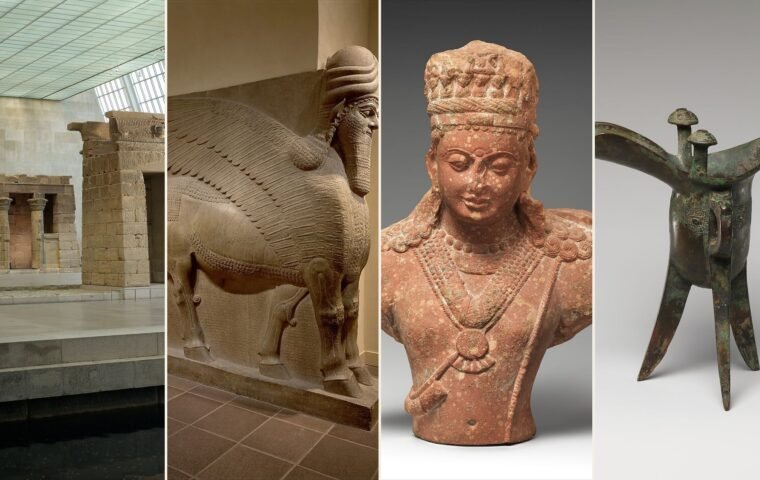
A timeline becomes useful when it sends the reader sideways as well as forward—toward simultaneous cultures, exchanges and survivals that refuse a single story of progress. Return to the opening image of Art History Timeline and notice how cave pigment, what changes in patronage and the example of Bhimbetka have changed the first impression. It allows a reader to choose a period and move into deeper artist, movement, civilisation and masterpiece pages without mistaking chronology for progress. Continue by placing Bhimbetka beside Sanchi, then follow the institutional record for the Parthenon; the comparison will expose which parts of the story are visual, documentary or interpretive. That shift—from quick recognition to a sustained relationship—is the habit The Easel wants every article to cultivate.
Sources and further reading
Explore connected guides
Choose a period and continue into its movement, artist or civilisation hub
Receive one masterpiece, one artist and one cultural-history story each week.
Join The Easel Weekly